
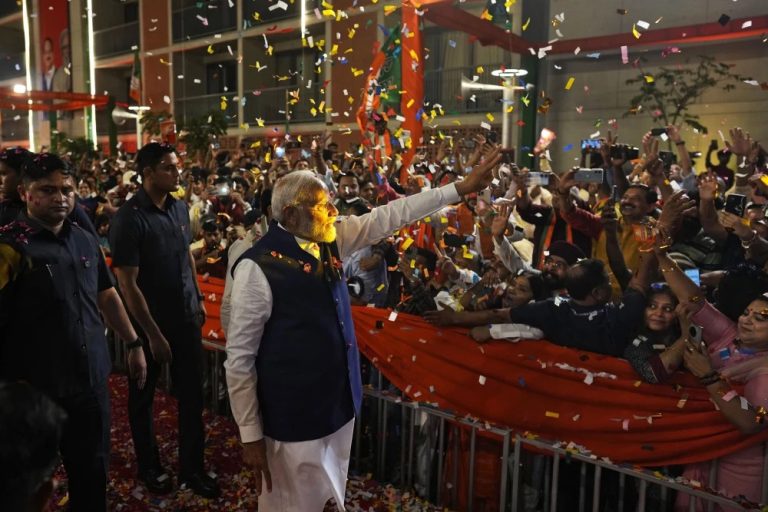

Narendra Modi on Wednesday tendered his resignation to the country’s President Droupadi Murmu, after his cabinet recommended the dissolution of the lower house of parliament Lok Sabha.
Murmu accepted the resignation of Modi and the council of ministers, requesting Modi to act as the prime minister till the new government is formed, an official of the President’s House said.
Modi’s resignation was a part of the protocol followed before the formation of the next government in the country.
The Election Commission of India released the official data on its website early Wednesday, suggesting that the ruling National Democratic Alliance, led by Modi’s Bharatiya Janata Party, is to form the next government.
How Modi lost his magic and his majority
Modi and his Bharatiya Janata Party (BJP) had come to dominate the world’s biggest democracy since coming to power 10 years ago, their Hindu nationalist politics becoming ever more entrenched in India along the way. Even as critics accused him of stocking religious tensions, eroding human rights and muzzling the press, Modi was consistently rated as the most popular leader in the world.

It was only in January that Modi, 73, inaugurated a grand Hindu temple on a contested holy site in the northern city of Ayodhya, fulfilling a longtime promise to supporters and stirring fear among India’s Muslim minority, who have found themselves increasingly marginalized under his rule.
It was a crowning moment for Modi that was expected to help him win favor with voters in Hindu-majority India as he sought a rare third term and a supermajority for his party in an election this year that was widely predicted to be a landslide.
Far from winning the supermajority of 400 seats it had promised, the BJP won 240 out of 543 seats in the lower house of India’s Parliament, according to final results. That’s far short of the 272 needed for a one-party simple majority like the ones it easily secured in the last two elections in 2014 and 2019.
But together with allied parties, the BJP has enough seats to form a coalition government and secure Modi a third five-year term.
On Wednesday, the Indian government said Modi and his cabinet had resigned as is standard practice after an election, with India’s president requesting that they remain in charge until a new government is formed. He and his new cabinet are scheduled to be sworn in on Saturday, local media reported.
Still, the election feels like a defeat for Modi and his ethnonationalist agenda — and a stunning victory for the opposition, which has struggled to gain traction for years and on Tuesday hailed the comeback of multiparty democracy.
“It’s rejection of a politics of hate,” said Rajeev Bhargava, director of the Institute of Indian Thought at the Jawaharlal Nehru University in Delhi.

“Ordinary Hindus and Muslims have lived together peacefully, and they don’t like divisions being created,” he said.
India’s fractured opposition knew defeating Modi was not going to be easy, forming an alliance that looked shaky during the campaign.
Their troubles were further compounded by the arrest of party leaders and the freezing of party funds for which they blamed the BJP, which denied the allegations.
So it was especially sweet when election results began to show their efforts paying off.
Leaders of the Indian National Congress, the main opposition party, said the BJP had made the election a referendum on Modi, and that the setback he had been dealt by voters was a “moral loss.”
Culled from NBC